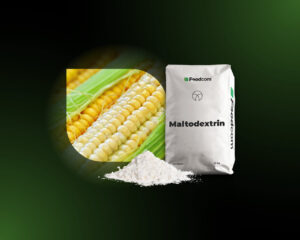
- Maltodextrin is a carbohydrate made of short glucose chains, produced by partial hydrolysis of starch (DE below 20).
- It is not an additive with an E number but a food ingredient; it is gluten-free, even when made from wheat.
- It provides about 380 kcal per 100 g and has a high glycaemic index, but it is only slightly sweet – about 10–20% as sweet as sugar.
- In food it is used as a flavour carrier, bulking agent and thickener, and in sport as a fast source of energy.
- It is safe for healthy people; mainly people with diabetes or insulin resistance should limit it.
In short: maltodextrin is a white, slightly sweet powder obtained by partially breaking down starch – usually corn, potato, wheat or rice starch. It is a complex carbohydrate providing about 380 kcal per 100 g, with a high glycaemic index. It is not an additive with an E number but an ordinary food ingredient. It is used as a flavour carrier, bulking agent and thickener in food and as a fast source of energy in sports nutrition. It is safe, but because it raises blood sugar quickly, people with diabetes should limit it.
What is maltodextrin?
Maltodextrin is a mixture of short glucose chains (oligo- and polysaccharides) produced by partial hydrolysis of starch – usually enzymatic, using amylases. The starch is broken down until the degree of hydrolysis, expressed as dextrose equivalent (DE), is below 20. Products with a DE above 20 are glucose syrups, and in dry form glucose syrup powder. After hydrolysis the solution is purified and spray-dried into a fine, free-flowing powder.
The raw material is corn, potato, tapioca, rice or wheat starch. In the EU maltodextrin is not a food additive and has no E number – it is an ingredient, like starch or sugar. The label “E1400” sometimes seen is incorrect: it formerly referred to roasted dextrins, which are not classified as additives today either. Maltodextrins belong to a wider group of products made from enzymatically treated starch, which we describe in the article Modified starch – types and uses.
What are the properties of maltodextrin?
The properties of maltodextrin depend mainly on its DE value: the lower the DE, the longer the glucose chains, the higher the viscosity and the lower the sweetness.
| Property | Maltodextrin |
|---|---|
| Appearance | white or cream powder with a neutral odour |
| Taste | slightly sweet – about 10–20% as sweet as sugar |
| Energy value | approx. 380 kcal per 100 g (4 kcal/g) |
| Glycaemic index | high – usually given as approx. 85–105 |
| Dextrose equivalent (DE) | from 3 to 20, most often 10–12 or 18–20 |
| Solubility | very good in cold and warm water |
| Gluten | gluten-free, including wheat-based maltodextrin |
Low-DE maltodextrins form films well and increase viscosity, so they are used as carriers and thickeners. Higher-DE grades are slightly sweeter, more soluble and more hygroscopic, which suits beverages and sports products.
Maltodextrin vs sugar – how does it differ from glucose and sucrose?
Maltodextrin is made of glucose but is not a sugar in the labelling sense. In the body, however, it is broken down into glucose very quickly, so its effect on blood sugar is similar to that of glucose:
| Property | Maltodextrin | Glucose (dextrose) | Sucrose (sugar) |
|---|---|---|---|
| Structure | chains of many glucose molecules | single molecule (monosaccharide) | glucose + fructose (disaccharide) |
| Sweetness (sugar = 100) | approx. 10–20 | approx. 70–80 | 100 |
| Glycaemic index | approx. 85–105 | 100 | approx. 65 |
| Energy value | approx. 4 kcal/g | approx. 4 kcal/g | approx. 4 kcal/g |
| On the label | carbohydrates, only slightly sugars | sugars | sugars |
This is why a product with maltodextrin can show little “sugar” on the label and still raise blood glucose quickly.
What is maltodextrin used for in the food industry?
Maltodextrin is one of the most widely used technological ingredients because it is inexpensive, neutral in taste and dissolves well. It is used mainly as:
- a carrier for flavours, colours and vitamins – in spray drying it coats flavour droplets and protects them from oxidation (microencapsulation),
- a bulking agent – it adds mass without excessive sweetness, e.g. in seasoning blends and tabletop sweeteners,
- a thickener and texture stabiliser – in instant soups and sauces, desserts and fillings,
- a partial fat replacer – low-DE maltodextrins form gels that give creaminess to light products,
- a solubility improver – in instant drinks, cocoa and nutritional powders,
- a carbohydrate source – in infant formula and foods for special medical purposes.
In confectionery it limits sugar crystallisation and drying out, and in pharmaceuticals it is used as a filler and binder in tablets.
Maltodextrin in sports – how to use it?
Maltodextrin is digested quickly, dissolves well and is only slightly sweet, so it can be used to make a high-carbohydrate drink that is not cloying. According to current sports nutrition guidelines, during exercise lasting 1–2.5 hours it is worth taking about 30–60 g of carbohydrates per hour, and in longer events up to 90 g. At such high intakes maltodextrin or glucose is combined with fructose (usually in a ratio of about 2:1), because the two sugars are absorbed by different transporters. Read more in the article Fructose – what it is and where it is found.
After training, maltodextrin together with protein, e.g. whey protein concentrate, speeds up the replenishment of muscle glycogen. For short, moderate workouts, however, it is not needed – water and a normal, balanced meal are enough.

Is maltodextrin harmful?
For a healthy person, maltodextrin consumed in typical amounts is safe – it is an easily digestible carbohydrate that the body breaks down into glucose. A few points are worth noting:
- diabetes and insulin resistance – the high glycaemic index causes a rapid rise in blood glucose; maltodextrin must be counted as carbohydrate, also in products marketed as “sugar-free”,
- excess calories – in processed food maltodextrin provides energy without vitamins or fibre,
- gut microbiota – animal studies suggest that large amounts of maltodextrin may affect gut bacteria and the intestinal mucus layer; there is no clear evidence of this in humans, but people with inflammatory bowel disease may prefer to limit it,
- gluten – maltodextrin is gluten-free, including wheat-based maltodextrin, because cereal proteins are removed during production; this is why in the EU wheat-based maltodextrin is exempt from allergen labelling,
- infants – maltodextrin is a permitted carbohydrate source in infant formula; however, it should not be added to a child’s diet on your own.
Resistant maltodextrin, used in fibre supplements among other things, is a separate category. It is not digested in the small intestine, acts like dietary fibre and has a low glycaemic index.
How to choose maltodextrin for production?
For food and supplement manufacturers, the key parameters are the DE value (which determines sweetness, viscosity and hygroscopicity), the raw material (corn, potato, wheat), moisture and particle size, microbiological purity and declarations such as gluten-free or non-GMO. Maltodextrins with DE 10–12 work well as carriers and thickeners, while DE 18–20 grades suit beverages and sports nutrition.
Foodcom supplies maltodextrin in industrial packaging with full quality documentation. For specifications, DE values and availability, contact our sales team.