- MSM (methylsulfonylmethane, dimethyl sulphone) is an organic sulphur compound with the formula (CH₃)₂SO₂, containing approx. 34% sulphur.
- It occurs naturally in trace amounts in milk, coffee, tea and vegetables; for supplements it is produced by oxidising DMSO.
- Studies point to a possible anti-inflammatory effect and relief of joint pain, but they are few in number – in the EU, MSM has no approved health claims.
- Studies typically used 1.5–6 g per day; the most common side effects are mild gastrointestinal complaints.
- For manufacturers, what matters is purity (min. 99.9%), the purification method (distillation or crystallisation) and particle size.
In short: MSM, or methylsulfonylmethane (dimethyl sulphone), is an organic sulphur compound with the formula (CH₃)₂SO₂ – commonly referred to as organic sulphur. It is a white, odourless powder containing approx. 34% sulphur. It occurs in food only in trace amounts, so for food supplements it is produced industrially. It is used mainly in joint supplements, sports nutrition products and “beauty from within” products for skin, hair and nails. Studies suggest an anti-inflammatory effect and a reduction in joint pain, but they are few in number, and in the EU MSM has no approved health claims. At typical doses (1–3 g per day) it is well tolerated.
What is MSM, or organic sulphur?
MSM stands for methylsulfonylmethane. The same compound is also known as dimethyl sulphone (DMSO₂). It is an organic sulphur compound in which a sulphur atom is bonded to two methyl groups and two oxygen atoms. Sulphur makes up approx. 34% of its mass, which is why MSM is often regarded as a convenient source of sulphur in supplements.
The term “organic sulphur” is a colloquial one. In the body, sulphur is present in many organic compounds – above all in the amino acids methionine and cysteine, as well as in glutathione, keratin, collagen, coenzyme A, biotin and thiamine. The main dietary source of sulphur is protein, not MSM. However, when people talk about an “organic sulphur” supplement, they almost always mean MSM. On product labels it usually appears as MSM or organic sulphur.
MSM is also a natural metabolite of DMSO (dimethyl sulphoxide). In the body, part of it is excreted unchanged in the urine, while some of the sulphur may be incorporated into sulphur-containing compounds such as methionine.
What is the formula of MSM and what are its properties?
Methylsulfonylmethane is a simple and very stable compound. Its key parameters:
| Property | MSM (methylsulfonylmethane) |
|---|---|
| Molecular formula | C₂H₆O₂S |
| Condensed structural formula | (CH₃)₂SO₂, i.e. CH₃–SO₂–CH₃ |
| Molar mass | 94.13 g/mol |
| Sulphur content | approx. 34% |
| CAS number | 67-71-0 |
| Form | white crystalline powder or granules, odourless, with a slightly bitter taste |
| Melting point | approx. 109°C |
| Boiling point | approx. 238°C |
| Solubility | readily soluble in water, less soluble in ethanol |
MSM has low chemical reactivity, does not break down in typical food and supplement manufacturing processes and is resistant to high temperatures. It lacks the characteristic odour of DMSO. Its slightly bitter taste needs to be taken into account when formulating beverages and powders for dissolving.

Where does MSM occur and how is it produced?
MSM is part of the natural sulphur cycle. Phytoplankton in the oceans produce dimethyl sulphide, which oxidises in the atmosphere to DMSO and MSM and then reaches the soil and plants with rainfall. This is why MSM is found in food, but only in trace amounts – in the order of milligrams per kilogram or less. The highest levels are reported for:
- cow’s milk,
- coffee and tea,
- tomatoes, Swiss chard, maize and alfalfa,
- beer.
The diet therefore provides MSM in milligram amounts, whereas supplements and studies use grams per day. The compound is also sensitive to cooking and food processing.
The MSM used in supplements is produced industrially – most often by oxidising DMSO with hydrogen peroxide. The raw material is then purified by distillation or crystallisation. Distillation makes it possible to achieve very high purity, usually at least 99.9%. MSM obtained in this way is chemically identical to naturally occurring MSM.

What is MSM good for and what does the research say?
The health properties of MSM have mainly been examined in small clinical trials and animal studies. The results are promising but need to be confirmed in larger studies:
| Area | What was studied | Result |
|---|---|---|
| Joints | people with knee osteoarthritis, 6 g of MSM per day for 12 weeks | moderate reduction in pain and improved joint function compared with placebo |
| Physical exercise | people who train, supplementation for approx. 10 days before exercise | lower markers of muscle damage and better antioxidant status after exercise |
| Inflammation and oxidative stress | cell, animal and human studies | reduction in some inflammatory markers (e.g. IL-6, TNF-α) and an increase in glutathione levels |
| Skin, hair and nails | studies with an MSM supplement for 8–16 weeks | improved appearance of the skin and condition of hair and nails, as assessed by researchers and participants |
| Seasonal allergies | open-label study without a control group | reduced symptoms of rhinitis; no placebo-controlled studies |
The best-documented effects of MSM concern joint pain and recovery after exercise, often in combination with glucosamine and chondroitin. However, many studies were short, involved small groups and were funded by manufacturers. MSM is not a medicine – it cannot replace the treatment of joint disease, allergies or liver disease.
Does MSM have approved health claims in the EU?
No. The EU Register of nutrition and health claims contains no authorised claim for MSM. The label and advertising of a supplement therefore cannot state that MSM “supports joints”, “has an anti-inflammatory effect” or “strengthens immunity”.
Manufacturers get around this by combining MSM with ingredients that do have approved claims. Most often this is vitamin C, which contributes to normal collagen formation for the normal function of cartilage, bones and skin. Manganese (contributes to the normal formation of connective tissue) is used in a similar way, as are zinc, selenium and biotin in hair and nail products.
In the EU, MSM is used primarily in food supplements. Before using it in other food categories, such as beverages or bars, it is worth checking its status under the EU novel food regulations.
How should MSM be dosed?
There is no officially established daily dose of MSM. Clinical studies have typically used 1.5 to 6 g per day, while supplements on the market most often recommend 1–3 g per day. A few practical guidelines:
- supplementation usually starts with a lower dose (approx. 0.5–1 g), which is then increased gradually,
- larger doses are split into 2–3 portions and taken with meals, which reduces the risk of stomach upset,
- the powder is dissolved in water or juice because of its slightly bitter taste,
- in studies, effects were assessed after several weeks (usually 4–12) of regular use,
- the dose stated by the manufacturer on the label should not be exceeded.
MSM is commonly combined with vitamin C, collagen, glucosamine and chondroitin. Pregnant and breastfeeding women, children and people receiving long-term treatment should consult a doctor before taking supplements.
Is MSM safe and what are its side effects?
MSM has very low toxicity. In the United States, the FDA raised no objections to its recognition as generally recognised as safe (GRAS) for use in food, and in clinical trials doses of up to 6 g per day for 12 weeks were well tolerated.
Possible side effects are usually mild and transient:
- nausea, bloating, diarrhoea or stomach discomfort,
- headache and tiredness,
- difficulty falling asleep if MSM is taken in the evening,
- rarely, itching or a skin rash.
Contraindications and situations requiring caution are mainly pregnancy and breastfeeding (no studies available), childhood, hypersensitivity to any ingredient of the product, and taking anticoagulants or being treated for chronic conditions – in such cases the decision to supplement is best made with a doctor. In animal studies MSM did not damage the liver, and in some it had a protective effect; however, there are no studies in people with liver disease.
How does MSM differ from DMSO and other sources of sulphur?
MSM is sometimes confused with other sulphur compounds. The key differences:
| Compound | What it is | Use |
|---|---|---|
| MSM (methylsulfonylmethane) | odourless, solid sulphur compound, an oxidation product of DMSO | food supplements, cosmetics, animal feed |
| DMSO (dimethyl sulphoxide) | liquid with a garlic-like odour, a powerful solvent | industrial solvent, some topical medicines |
| Sulphur amino acids (methionine, cysteine) | building blocks of proteins | main dietary source of sulphur (meat, fish, eggs, dairy, pulses) |
| Sulphates (e.g. glucosamine sulphate, chondroitin sulphate) | salts and esters of sulphuric acid | joint supplements, food additives |
| Elemental sulphur | yellow solid | chemical industry, agriculture; not a supplement |
People who eat enough protein are usually not deficient in sulphur, which is why MSM is regarded more as a functional ingredient than as a way of correcting a deficiency.
Where is MSM used in industry?
MSM is stable, easy to process and combines well with other ingredients, which is why manufacturers use it in many product categories:
- joint supplements – combined with glucosamine, chondroitin, collagen and hyaluronic acid; you can read more about collagen in the article Collagen – what it is and how it is used,
- sports supplements – products supporting post-workout recovery,
- “beauty from within” – supplements for skin, hair and nails, often with vitamin C, biotin and zinc,
- cosmetics – creams, massage gels, shampoos and conditioners; MSM helps other ingredients penetrate the epidermis,
- animal feed and supplements – especially for horses, dogs and cattle, as we describe in the article MSM for horses – properties and uses.
MSM can be used in tablets, capsules, powders and sachets. According to Credence Research, the global MSM market was worth approx. USD 1.66 billion in 2022 and is expected to grow by approx. 3.7% a year until 2030.
How do you choose MSM for supplement manufacturing?
When buying MSM as a raw material, it is worth paying attention to:
- purity – min. 99.9% for distilled MSM,
- purification method – distillation usually yields higher purity than crystallisation alone,
- particle size – fine powder for capsules and blends, granules for direct compression into tablets,
- impurities – residual DMSO content, heavy metals and microbiological purity,
- documentation – specification, certificate of analysis, gluten-free, vegan, halal or kosher declarations.
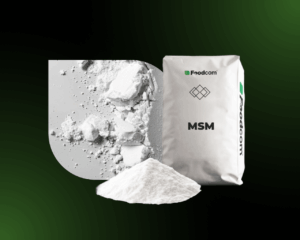
Foodcom supplies MSM (methylsulfonylmethane) in industrial packaging with full quality documentation. We also offer a ready-made food supplement, Foodcom MSM powder. For specifications, particle sizes and availability, please contact our sales team.
Bibliography:
- Barmaki, S., Bohlooli, S., Khoshkhahesh, F., Nakhostin-Roohi, B. (2012). Effect of methylsulfonylmethane supplementation on exercise – Induced muscle damage and total antioxidant capacity. The Journal of Sports Medicine and Physical Fitness, 52 (2): 170-4
- Barrager, E., Veltmann Jr, J. R., Schauss, A. G., & Schiller, R. N. (2002). A multicentered, open-label trial on the safety and efficacy of methylsulfonylmethane in the treatment of seasonal allergic rhinitis. Journal of Alternative & Complementary Medicine, 8(2), 167-173
- Butawan, M., Benjamin, R. L., & Bloomer, R. J. (2017). Methylsulfonylmethane: Applications and Safety of a Novel Dietary Supplement. Nutrients, 9(3), 290
- Debbi, E. M., Agar, G., Fichman, G., et al. (2011). Efficacy of methylsulfonylmethane supplementation on osteoarthritis of the knee: a randomized controlled study. BMC Complementary and Alternative Medicine, 11(1), 50
- DiSilvestro, R. A., DiSilvestro, D. J., DiSilvestro, D. J. (2008). Methylsulfonylmethane (MSM) Intake in Mice Produces Elevated Liver Glutathione and Partially Protects Against Carbon Tetrachloride-Induced Liver Injury. FASEB J. 22 (1): 445-8
- Muizzuddin, N., Benjamin, R, (2019). Beneficial Effects of a Sulfur-Containing Supplement on Hair and Nail Condition. Natural Medicine Journal, 11(11): 1-8
- Muizzuddin, N., Benjamin, R. (2020). Beauty from within: Oral administration of a sulfur-containing supplement methylsulfonylmethane improves signs of skin ageing. International Journal for Vitamin and Nutrition Research, 92(3-4): 182-191