- EU gas prices hit their highest level since 2022, with Brent crude near USD 114.
- Corn prices fall 10%, but imports from China become more expensive due to freight costs and a weaker euro.
- Citric acid: duties of 33.8–42.7%, with two EU reviews underway.
- New in the EU: curdlan (E 424) and a new production pathway for rebaudioside M.
October brought mixed signals for buyers of food additives. Energy costs in Europe and China rose to levels not seen in several years, while at the same time corn—one of the most important fermentation feedstocks—became significantly cheaper. Freight rates and the euro exchange rate also affected the cost of shipping goods from Asia, and new regulations regarding food additives came into effect in the EU. Below, we summarize the most important changes from October 15–29 and explain what they may mean for purchasing planning.
Market Summary
In the second half of October, energy costs rose: gas prices in the EU reached their highest level since December 2022, while Brent crude hit a six-month high following attacks on energy facilities in the Persian Gulf. Corn moved in the opposite direction, falling by about 10% since the end of September. However, higher Asia–Europe freight rates and a weaker euro drove up the cost of shipping Chinese-sourced additives, so the cheaper raw material did not directly translate into lower prices for buyers in Europe. The EU has approved kurdlan (E 424), and rebaudioside M has gained a new production route.
Price Factors
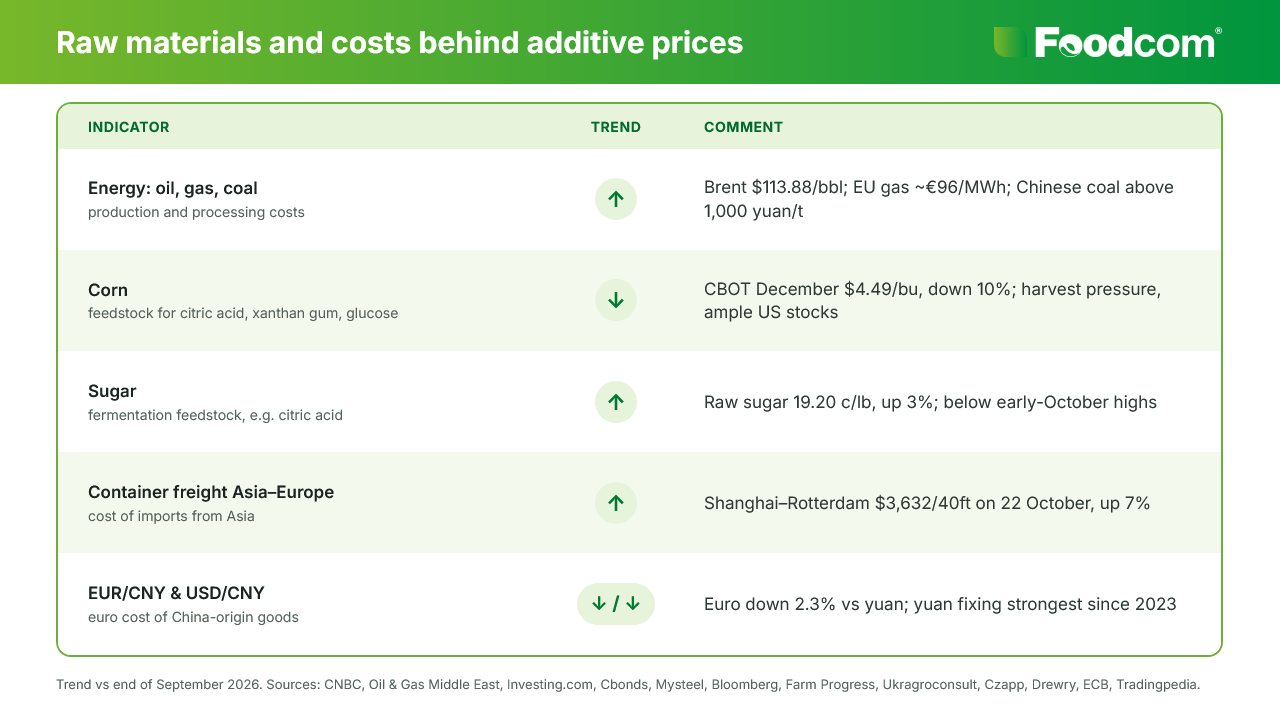
Energy had the greatest impact on costs. Brent closed at $116.72 per barrel on October 23, its highest level since late April, while talks in Tehran brought the price down to $113.88 on October 27. TTF gas cost approximately 96 EUR/MWh at the end of the month, compared to 72.36 EUR/MWh at the end of September, and EU storage facilities were 74.6% full on October 22, more than 10 percentage points below the five-year average. In China, thermal coal exceeded 1,000 yuan per metric ton on October 10 following inspections at mines and a decline in imports from Indonesia; prices have been correcting slightly since October 21.
Corn prices fell following a higher-than-expected U.S. inventory report and amid harvest pressure. The Shanghai–Rotterdam freight rate rose from $3,399 (October 1) to $3,632 (October 22), while the euro weakened against the yuan from 7.6130 to 7.4343.
Product in the spotlight: citric acid (E 330)
This month’s cost signals are mixed for citric acid. Corn, its main raw material in China, has fallen in price by about 10%, while Chinese thermal coal, which powers fermentation and drying, cost over 1,000 yuan/metric ton for most of October. For buyers in the EU, trade policy is just as important as costs: anti-dumping duties ranging from 33.8% to 42.7% on Chinese producers remain in effect, and the European Commission is conducting an expiry review (effective April 14, 2026) and a separate interim review (effective September 14, 2026), which could alter the rates. A weaker euro and higher freight costs further increase delivery costs, so it is worth taking these factors into account when planning contracts for 2027.
Industry News
- The EU has authorized kurdlan (E 424). Regulation (EU) 2026/2298, published on October 19 and effective as of November 8, includes this fermentation-derived gelling agent, stabilizer, and thickener in the category of, among others, sauces, soups, and gluten-free pasta. Why it matters: Manufacturers now have access to a heat-activated gelling agent that was previously not permitted in the EU.
- A new production pathway for rebaudioside M. Regulation (EU) 2026/2309, published on the same day, allows manufacturers of rebaudioside M produced by enzymatic conversion to use enzymes from genetically modified yeast and introduces a limit on kaurenic acid. Why it matters: This could expand the supplier base for high-purity steviol sweeteners.
- The CJEU is set to distinguish between food additives and processing aids. A request for a preliminary ruling from the Bavarian Court of Appeal in Case C-727/26 (Vital Products) was published in the Official Journal of the EU on October 26. Why it matters: The ruling could change how certain ingredients are authorized and labeled.
What to watch for
- U.S.-Iran talks and Houthi attacks on Saudi energy facilities, which influence oil and gas prices.
- EU gas storage levels at the start of the heating season—74.6% full as of October 22.
- Capacity on the Asia–Europe route following carriers’ announcement of eight canceled sailings per week starting October 22.
Contact
Planning to purchase additives for early 2027? Contact the Foodcom S.A. team.