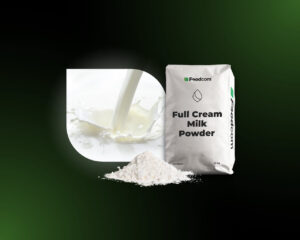
- Milk powder is concentrated and dried fresh pasteurized milk.
- The product comes in full-fat, skimmed and greased versions, as well as in instant form.
- Powdered milk has a long shelf life and high stability.
- It is mainly used in the food industry, as well as in the production of baby food, dietary supplements, cosmetics and feed.
Fresh milk contains about 87% water. Removing the water results in a concentrated product with a longer shelf life that is easier to store, transport, and dispense. For this reason, milk powder is an important raw material for the dairy and food industries.
Various types are available on the market, differing in fat content, composition, and processing properties. The choice of the appropriate type depends primarily on the intended use of the raw material.
What is powdered milk?
Powdered milk is produced by removing most of the water from liquid milk. The finished product contains concentrated milk solids—primarily proteins, lactose, minerals, and, depending on the type, milk fat.
The low water content increases the product’s stability and limits conditions conducive to the growth of microorganisms. Powdered milk also takes up less space than an equivalent amount of liquid milk, which facilitates transportation and storage.
How is powdered milk made?
The production of powdered milk involves several stages that affect the product’s quality, solubility, and functional properties.
First, the milk is inspected and standardized, including for fat content. It is then pasteurized, a process that ensures appropriate microbiological quality and may affect the properties of milk proteins.
The next stage is concentration. A significant portion of the water is removed in evaporators, usually under reduced pressure, thereby increasing the dry matter content.
Spray drying is a key stage. The concentrated milk is atomized into fine droplets in a drying chamber, from which the water quickly evaporates under the influence of hot air. The resulting powder is then cooled, sieved, and packaged.
For instant products, agglomeration—the process of combining fine particles into larger structures—may also be used. This improves wettability and dispersibility and makes it easier to dissolve the powder in water.
Types of Powdered Milk
One of the main criteria for classifying milk powder is its fat content.
Whole milk powder (WMP) contains at least 26% milk fat. It is primarily used in applications where creaminess, a richer flavor, and the presence of natural milk fat are important.
Skim milk powder (SMP) contains a maximum of 1.5% fat. It is a source of milk proteins, lactose, and minerals, and a popular ingredient for increasing dry matter and protein content.
Partially skimmed milk powder is also available, as well as instant and lactose-free varieties.
Fat-filled milk powder (FFMP) constitutes a separate category, in which milk fat is partially or completely replaced with vegetable fat. Due to its different composition, it is not a direct equivalent of WMP.
Composition of Milk Powder
The composition of milk powder depends primarily on the type of milk used and its degree of skimming. The main components of milk powder are milk proteins, lactose, fat, minerals, and a small amount of water.
A standard product contains a maximum of about 5% water. It provides, among other things, calcium, phosphorus, potassium, and magnesium, as well as vitamins naturally found in milk.
Per 100 g of powder, the nutrients are more concentrated than in the same amount of liquid milk, since most of the water has been removed. When reconstituted with the appropriate amount of water, the proportions become much more similar.
The most important difference between WMP and SMP concerns fat content. In SMP, a larger proportion consists of protein, lactose, and minerals, while WMP retains a significant amount of milk fat.
Properties of Powdered Milk
Powdered milk typically takes the form of a homogeneous powder ranging in color from white to cream and possessing a characteristic milky taste and aroma.
In industrial applications, its functional properties are of particular importance. Milk proteins influence, among other things, water binding, emulsification, foaming, gelling, viscosity, and the structure of the finished product.
Lactose, together with proteins, can participate in reactions occurring during heat treatment, affecting the color, aroma, and flavor of baked goods and confectionery products.
The solubility, wettability, and dispersibility of the powder are also important. These parameters depend on the production technology and the intended use of a specific product.
What is made from powdered milk?
Powdered milk can be used to prepare reconstituted milk; however, in the food industry, it is much more commonly used as an ingredient in other products. It is used, among other things, in ice cream, desserts, yogurt, chocolate, creams, and fillings, as well as in baked goods, cakes, cookies, milk drinks, soups, instant sauces, and powdered mixes.
Its role depends on the type of product and the recipe. WMP works well where milk fat, creaminess, and a richer flavor profile are important. SMP is often used to increase protein and dry matter content while maintaining a low fat content.
Milk powder can also influence the processing properties of the finished product. Milk proteins support water binding, emulsion stability, and structure formation, and in baking and confectionery, milk components contribute to the characteristic color and aroma during heat treatment.
In industrial production, another advantage of powdered milk is the ability to precisely measure out ingredients and standardize recipes, which makes it easier to maintain consistent parameters for the final product.
Is powdered milk healthy?
Powdered milk retains many of the nutrients naturally found in milk, including complete protein, calcium, phosphorus, and other minerals. Removing water does not, therefore, result in the loss of the essential components of milk solids.
The nutritional value depends on the type of product. WMP contains more fat and has a higher energy value, while SMP is characterized by a significantly lower fat content.
Heat treatment and storage can affect some of the components and lead, among other things, to the Maillard reaction or fat oxidation. The intensity of these processes depends on temperature, humidity, oxygen exposure, and storage time. Therefore, a product’s value is best assessed based on its specific composition and quality.
The harmfulness of Powdered Milk – is there cause for concern?
Properly produced and stored powdered milk is not considered harmful simply because of its powdered form.
However, individual tolerance to milk components is a factor. Standard products contain lactose, so they may cause discomfort in people with lactose intolerance. In such cases, lactose-free options are available.
Powdered milk also contains milk proteins, which can trigger an allergic reaction. Lactose-free products still contain these proteins, so they are not a suitable option for people with a milk allergy.
With whole milk powder, it’s also worth noting the higher fat content and caloric value. However, this fact alone does not mean the product is harmful—what matters is the amount consumed and its role in the overall diet.
How should you store powdered milk?
The shelf life of powdered milk depends on its fat content, the type of packaging, and storage conditions. Protecting the product from moisture is particularly important.
Powdered milk should be stored in a tightly sealed container, in a cool, dry place, away from light and heat sources. Moisture can cause clumping and reduce solubility, while high temperatures and exposure to oxygen accelerate oxidation, especially in products with a higher fat content.
Once opened, follow the storage instructions provided by the manufacturer.
Powdered Milk in the food industry
Powdered milk is an important raw material in the international trade of dairy products. Its long shelf life, smaller volume compared to liquid milk, and the ability to tailor the raw material’s parameters to a specific production process make it widely used in the food industry.
Foodcom S.A. supplies B2B customers with dairy products intended for various industrial applications, including whole milk powder (WMP) and skim milk powder (SMP). When selecting the right product, factors such as fat and protein content, functional properties, packaging requirements, and the raw material’s end use are important.
Its concentrated composition and durable, user-friendly form make milk powder suitable for use in many product categories—from baked goods and confectionery to dairy products, desserts, and instant mixes.