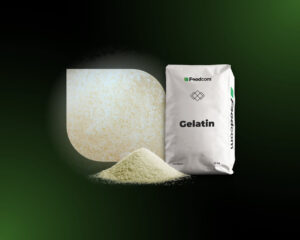
- Gelatin is a product of animal origin, obtained by hidrolysis of Collagen.
- Gelatine is barmy, viscous, capable of gelling and has no taste.
- Mostly it can be used in medicine and in the manufacture of cosmetics.
Gelatin is widely used in the food, pharmaceutical, and cosmetics industries. It is thanks to gelatin that gummy candies have their characteristic springiness, desserts maintain the right consistency, and pharmaceutical capsules can take on a specific shape. However, its applications extend far beyond these best-known examples.
Not all gelatin has the same properties. Depending on its origin, production method, and technical parameters, it may behave differently in the final product. What exactly is gelatin, what types are there, and what should you look for when choosing the right product?
What is gelatin, and what is it made from?
Gelatin is a protein of animal origin obtained through the partial hydrolysis of collagen. Collagen occurs naturally in the connective tissues of animals, primarily in the skin, bones, and tendons. It is the primary raw material used in gelatin production.
The process begins with purifying the raw material and subjecting it to acid or alkali treatment. Next, extraction is carried out using hot water, and the resulting solution is filtered, concentrated, and dried. Finished gelatin is most commonly available in the form of powder, granules, or flakes.
It is virtually tasteless and odorless, allowing it to be used in various products without significantly affecting their flavor. After being properly rehydrated and dissolved in warm water, and then cooled, it forms a gel. It is precisely this property that makes it so widely used in food production.
What are the different types of gelatin?
Gelatin is primarily classified based on the source of the raw material. In the food industry, pork, beef, and fish gelatin are most commonly used. The different types vary in their properties, so not every type of gelatin will work in the same recipe.
Pork gelatin
Pork gelatin is obtained mainly from pig skins. It is widely used in confectionery, particularly in the production of gummies, marshmallows, and jellies. It is also used in meat products and certain pharmaceutical products.
Beef gelatin
Beef gelatin is made from cattle hides and bones. It is used in the food and pharmaceutical industries, as well as in the production of dietary supplements. It may be chosen by manufacturers who, due to the requirements of their target market, exclude pork-based raw materials.
Fish gelatin
Fish gelatin is primarily derived from fish skins. It serves as an alternative to gelatin derived from mammals; however, its properties depend on the fish species and the processing method.
Some types, particularly those derived from cold-water fish, form gels with a lower melting point. This must be taken into account in products that need to remain stable at higher temperatures.
In addition to its origin, gelatin is classified according to its production method. There are two types: Type A, obtained through an acid-based process, and Type B, produced through an alkaline treatment. They differ in their physicochemical properties, but the type alone does not determine the quality of the product.
What are the properties of gelatin?
Gelatin is valued primarily for its ability to gel, thicken, and stabilize products. It can also aid in the formation and maintenance of foam, a property utilized, among other things, in confectionery.
One of its characteristic features is thermoreversibility. Gelatin forms a gel when cooled and becomes liquid when reheated. This allows for the creation of products that retain their shape while gently melting in the mouth.
Its behavior is also influenced by the other ingredients in the recipe. Factors such as sugar concentration, acidity, and processing temperature play a role. Prolonged heating, especially in an acidic environment, can weaken its gelling properties.
What does the Bloom scale mean?
One of the basic parameters of gelatin is the Bloom value, which determines its gelling strength. The higher the value, the stronger the gel that can be obtained at the same concentration and under identical conditions.
For example, 280 Bloom gelatin forms a firmer gel than 180 Bloom gelatin. However, this does not mean that a higher value is always better. It all depends on the desired result.
In the production of gummy candies, firmness is important, whereas in delicate dairy desserts, a softer texture may be desirable. Using gelatin with too high a gelling strength without adjusting the recipe can result in an excessively firm consistency.
In addition to the Bloom value, manufacturers pay attention to viscosity, which affects how gelatin is mixed and dispensed.
What is gelatin used for? Industrial applications
Gelatin is primarily used in food production, but it also has a wide range of applications in the pharmaceutical and cosmetics industries.
Gelatin in the food industry
In confectionery, gelatin is used to make jelly candies, mousses, jellies, and fillings. It helps control their firmness, elasticity, and texture. In the case of mousses, it also helps maintain an aerated structure.
In the dairy industry, it is used in desserts, mousses, creams, and select fermented products. It can reduce water separation and ensure a uniform consistency. It is also used in some reduced-fat products, where it helps achieve the desired texture.
In meat production, gelatin is added to jellies, pâtés, and deli products. It facilitates the shaping and portioning of products, and in the case of meat jellies, it is responsible for their characteristic structure.
It serves a slightly different function in beverage production. In certain processes, including wine clarification, it is used to remove specific substances responsible for cloudiness.
Gelatin in the Pharmaceutical Industry
One of the main applications of gelatin in the pharmaceutical industry is the production of hard and soft capsule shells.
Hard capsules are most commonly used for products in powder or granule form. Soft capsules, on the other hand, are suitable for properly prepared liquid and semi-liquid substances, such as oils.
Gelatin intended for pharmaceutical applications must meet specific requirements regarding purity and technical specifications.
Gelatin in the Cosmetics Industry
In cosmetics, gelatin is used, among other things, in certain face masks, hair care products, and gel-based formulations.
Its film-forming properties allow it to create a thin layer on the surface of the skin or hair. It can also serve as a thickening agent, affecting the consistency of the cosmetic and how it is applied.

Gelatin vs. Hydrolyzed Collagen—How Do They Differ?
Although gelatin and hydrolyzed collagen share the same origin, they are not the same product. The difference stems primarily from the degree to which the collagen has been processed, which affects the properties of both ingredients.
Gelatin retains its ability to form a gel. Hydrolyzed collagen, also known as collagen peptides, undergoes further breakdown into shorter protein chains. As a result, it typically dissolves well in water and does not exhibit typical gelling properties.
In products requiring a springy texture, such as gummy candies or jellies, appropriately selected gelatin is used. Collagen peptides, on the other hand, are used in products such as functional beverages, nutritional supplements, and dietary supplements, where solubility is important without imparting a gel-like consistency to the product.
What should you look for when choosing gelatin?
The choice of gelatin depends primarily on its intended use. Before purchasing, it’s important to determine what consistency the finished product should have and what raw material parameters will be suitable for a given recipe.
The origin of the gelatin is also important. Manufacturers targeting specific markets may need Halal or Kosher certifications. However, a beef origin alone does not guarantee compliance with these requirements.
Before purchasing, it is advisable to check the technical specifications, including Bloom gel strength and viscosity. If the gelatin is to be used in a new recipe, it is a good idea to test it under production conditions beforehand.
Gelatin Offered by Foodcom S.A.
Foodcom S.A. supplies beef gelatin to industrial customers, including food manufacturers. The product is available in 25-kg packages, and detailed information regarding technical specifications and current availability can be obtained from our sales team.
Our sales representatives will help you select the right product and arrange delivery terms.
Are you looking for gelatin for your production? Contact Foodcom S.A. to learn about our current offerings.