- Corn starch is a plant-based ingredient used to thicken, bind water and improve product texture.
- It is widely used in food production, cosmetics, papermaking, adhesives and animal feed.
- Its performance depends on starch type, temperature, pH, water availability and processing conditions.
- Choosing the right corn starch requires evaluating technical specifications, quality documentation and intended applications.
Cornstarch is responsible for the thickness of sauces, the texture of fillings, and the consistency of many products whose quality depends on how their ingredients hold up during processing. Its importance, however, extends beyond food production. This raw material is also used in the paper industry, as well as in the production of adhesives, cosmetics, and animal feed. The suitability of a specific type of starch is determined primarily by its properties and the conditions of the process in which it is to be used.
What Is Corn Starch and How Is It Made
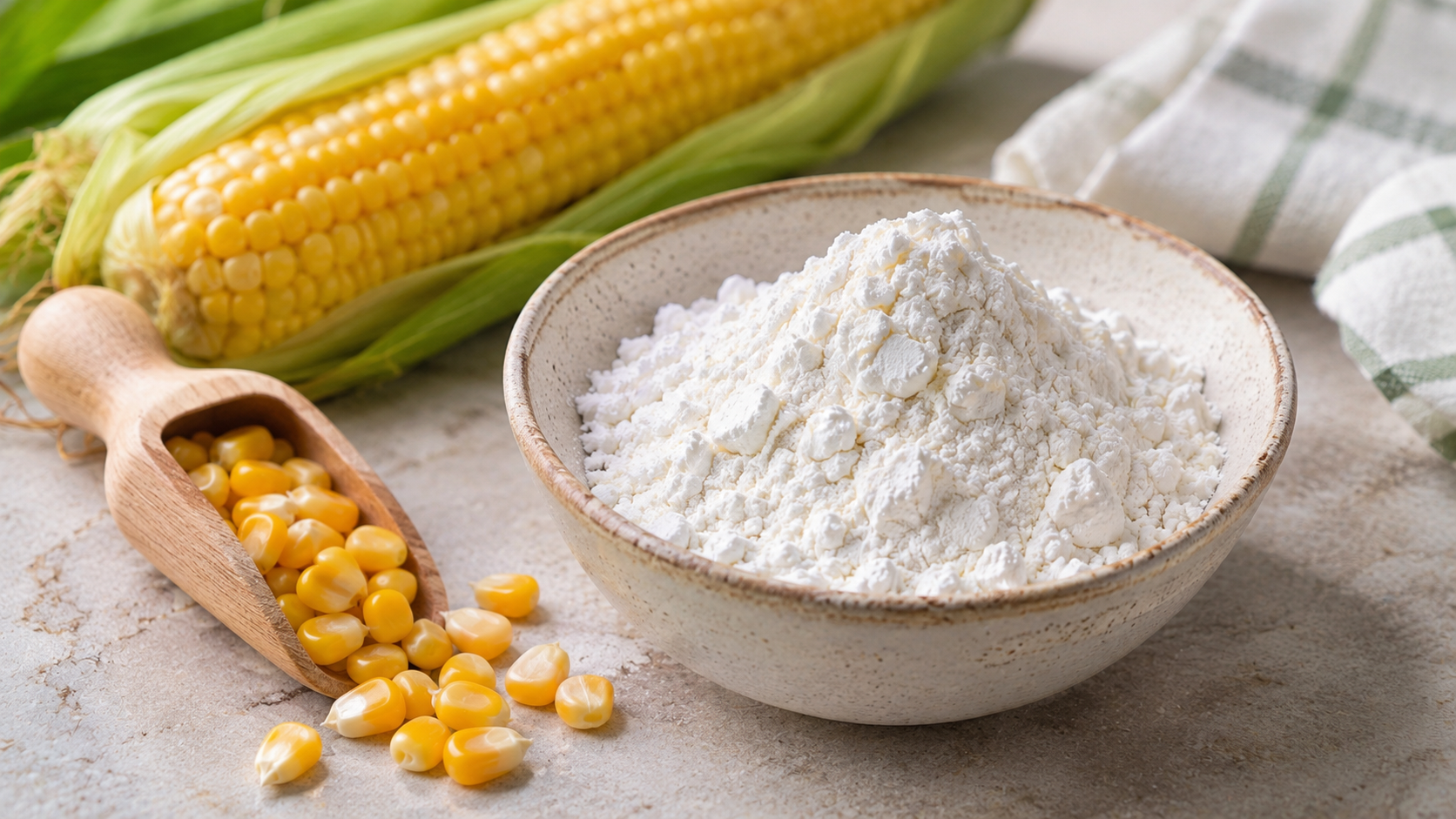
Starch is a storage carbohydrate that occurs naturally in plants. In corn, it is found primarily in the endosperm of the kernel, from which it is extracted during wet milling. The process involves cleaning and soaking the kernels, grinding them, and separating the germ, fiber, and protein fraction. The resulting starch suspension is purified, dewatered, and dried. The finished product is a fine, white or slightly yellowish powder with a neutral taste and odor.
Corn starch consists of amylose and amylopectin, two glucose polymers with different structures. Therefore, starch from standard corn varieties behaves differently than waxy starch, which is rich in amylopectin, or high-amylose varieties. In practice, botanical origin alone is therefore insufficient to determine the functionality of the raw material.
Native starch retains the fundamental structure of starch granules and is not intentionally modified to alter its technological properties. Starches that have undergone appropriate physical, enzymatic, or chemical processing constitute a separate group. The term “modified” in this context refers to the processing of the starch and does not automatically imply genetic modification of the corn.
Properties of Corn Starch in the Production Process
The most important technological property of starch is its ability to thicken water-containing systems. Native corn starch does not dissolve in cold water but forms a suspension. When heated in the presence of an adequate amount of water, the starch granules swell and lose their ordered structure. The gelatinization process leads to an increase in viscosity, causing the liquid mixture to take on a thicker consistency.
The effect depends on the starch concentration, water availability, temperature, and heating time. Sugars, fats, proteins, and the acidity of the formulation also play a role.
During cooling, standard cornstarch can form a gel. Over time, the starch chains rearrange themselves, a process known as retrogradation. This phenomenon may be accompanied by changes in texture and water release. This is particularly important in products stored in cold storage or subjected to freezing and thawing. Native starch does not automatically provide resistance to prolonged heating, high shear, or low pH. In demanding formulations, a different type of starch or a carefully selected blend of ingredients may be required.
Applications in the Food Industry
In food production, cornstarch is primarily used to control texture. In sauces and soups, it increases viscosity, and in creams, puddings, and fillings, it helps achieve the desired texture.
In baking and confectionery, it can influence the texture of baked goods and the properties of flour mixtures. It is also an ingredient in some breadings and coatings, where it helps achieve the desired structure after heat treatment. In gluten-free products, it is one of the ingredients in the recipe, but it does not, on its own, replicate the elastic gluten network. It is usually combined with other flours, proteins, and hydrocolloids.
Corn is naturally gluten-free; however, when developing gluten-free foods, the risk of contamination during production and transportation must also be taken into account. The suitability of a specific batch for such use should be determined by the supplier’s documentation and raw material inspection.
Corn Starch vs. Other Starches
Although they come from the same grain, corn starch and corn flour differ in composition and are not direct substitutes. Corn flour is produced by grinding the grain or parts of it and, in addition to starch, contains other components whose proportions depend on the production method. It may have a more pronounced color and flavor. Isolated starch is a raw material with a different composition and behavior in recipes.
The choice between corn starch and potato starch depends, among other things, on the expected gelatinization process, thickening power, and appearance of the finished gel. Potato starch typically swells significantly and produces clearer gruels, whereas standard corn starch may form more opaque mixtures and a gel upon cooling. Replacing one raw material with another in the same quantity does not necessarily guarantee an identical result.
Corn Starch in Cosmetics
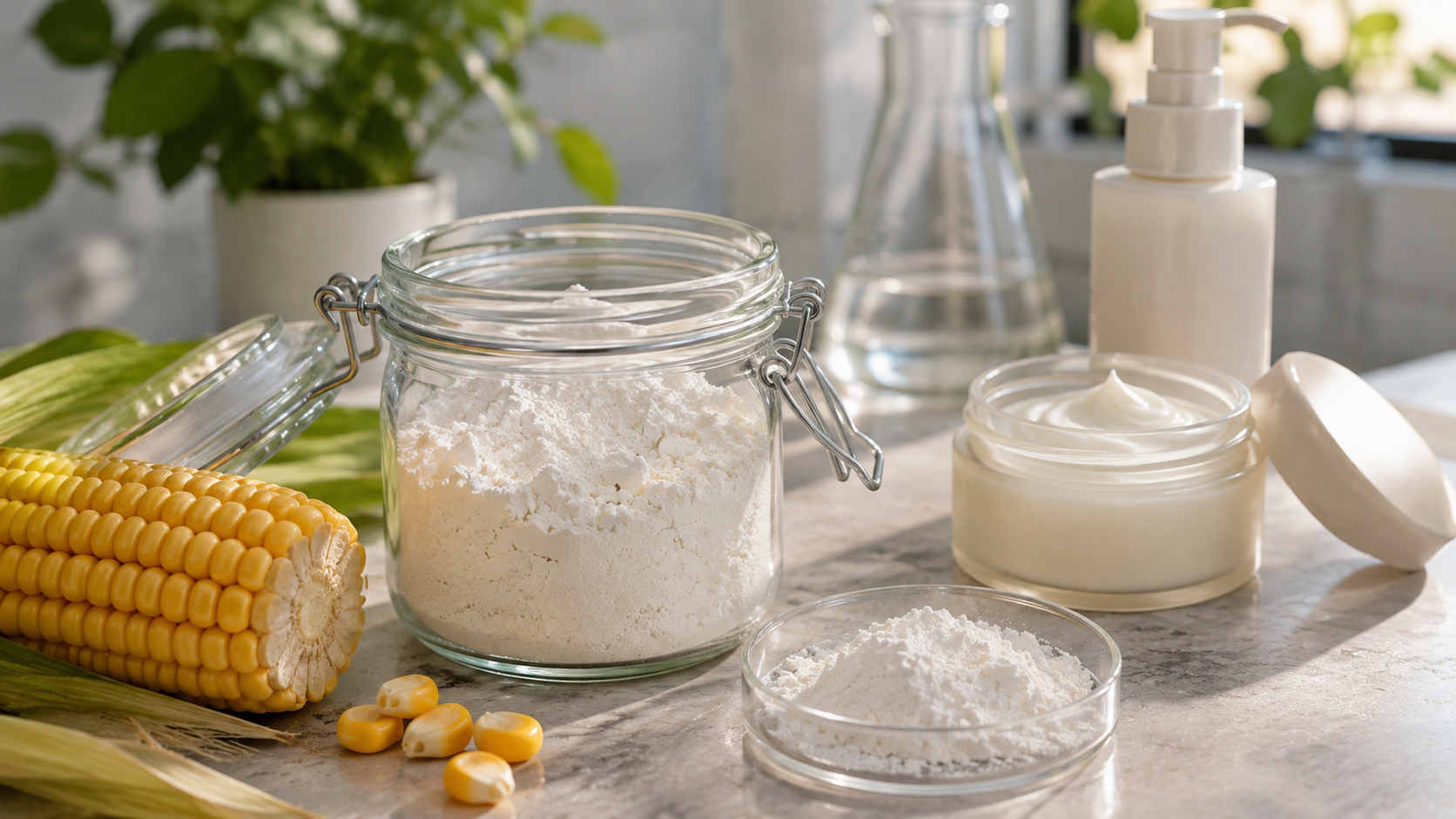
The use of corn starch in cosmetics is primarily related to its absorbent properties and its effect on the sensation during application. In INCI listings, it appears as Zea Mays Starch. It can be used in powders and other loose products, where it helps absorb moisture and reduce the greasy feeling on the skin.
Cosmetic formulations use both native starch and specialized starch-derived ingredients. One should not automatically assume they serve the same functions. Starch derivatives can be engineered for specific viscosity, resistance to formulation conditions, or sensory effects. Selecting a raw material requires verifying the INCI name, purity, and microbiological parameters, as well as testing the finished formulation. The fact that food-grade starch is edible does not automatically make it a suitable substitute for a cosmetic-grade raw material.
Technical Applications and Corn Starch for Animal Feed
In the paper industry, starch and its derivatives are used to improve the strength properties and surface characteristics of paper. Depending on the technology, they can aid in fiber bonding or the formation of a surface layer. In the production of corrugated cardboard, starch-based adhesives are used, whose action is based on carefully controlled gelatinization and the formation of a bond. The type of starch and the preparation of the adhesive must be suited to the operating conditions of the equipment.
Feed-grade corn starch serves a different purpose than starch used as a raw material in papermaking. In animal feed, it can provide energy and, in appropriate formulations, support the product’s structure. In extruded feeds, the transformation of starch under the influence of moisture, temperature, and mechanical forces contributes to the properties of the finished pellets. The species of animal, the composition of the feed ration, and the degree of raw material processing are all significant factors in this regard.
It is equally important to distinguish between quality grades: industrial-grade raw material cannot be treated as feed-grade simply because it comes from the same plant. The intended use of a batch should be determined by its specifications and documentation.
How to Choose the Right Corn Starch
Corn starch producers offer raw materials with varying parameters, so a comparison of offers should consider more than just the price per metric ton. Moisture content, purity, viscosity, and the gelatinization process all affect dosing and process consistency. When evaluating a supplier, batch traceability, quality documentation, GMO status, and industry-specific requirements are also important.
A technical trial should ideally be conducted under conditions as close as possible to actual production conditions, including cooling and storage of the finished product. This allows for an assessment of the raw material’s actual performance and helps avoid situations where the correct consistency immediately after production changes before the end of the shelf life.
Foodcom S.A. offers native corn starch for industrial applications. Providing details on application requirements, quality parameters, and order quantities allows us to prepare an offer tailored to your facility’s needs.