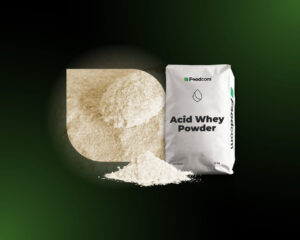

- Whey powder is a nutrient-rich dairy product obtained by drying the whey produced during cheese manufacturing.
- Various types of whey are available on the market, such as sweet whey, sour whey, and demineralized whey powder, in which the mineral content is reduced.
- It is a raw material widely used in baking, confectionery, beverages, dairy products, and food mixes.
Whey powder is one of the most versatile dairy ingredients used in modern food production. It combines good solubility, technological functionality, and a favorable flavor profile, which is why it is used in both simple recipes and more complex industrial formulations.
Whey powder – what is it?
Whey powder and sour whey powder are dairy products obtained by drying whey or sour whey. Whey itself is a liquid byproduct formed during the production of cheese, casein, or similar products – it is the liquid that remains after the milk curd is separated.
Thanks to spray drying, the raw material takes on a convenient, free-flowing form and a long shelf life, which is of great importance for industrial production. In practice, whey powder is valued not only for its composition but also for its ease of dosing, transport, and standardization of parameters.
Whey works well wherever a milky flavor, improved texture, support for browning processes, and convenient storage compared to the liquid form are important. This raw material also boasts valuable nutritional properties – it contains approximately 50% of the nutrients originally present in milk, including whey proteins, lactose, vitamins (particularly B vitamins), and minerals (calcium, phosphorus, and sodium).

Types and properties of whey powder
The most common types are sweet whey or rennet whey, acid whey, and demineralized whey powder. Whey protein is often the basis for protein supplements for athletes, such as whey protein concentrate, isolate, or hydrolysate.
Sweet whey, rennet whey
Sweet whey powder is produced by drying the whey concentrate generated during the production of rennet cheeses. It has a creamy-white color and a milky flavor. It is a rich source of lactose, to which it owes its sweet taste. It is widely used in baking, the production of dairy products, ice cream, beverages, sauces, and sports supplements. It is also found in animal feed, as well as in medicines and cosmetics.
Acid whey
Acid whey powder is made from whey derived from the production of cottage cheese or through advanced filtration processes of sweet whey. It has a creamy color and a lower pH than sweet whey (usually below 5). It has a sour, distinctive taste and contains more minerals, less lactose, and more lactic acid. It is used, among other things, in the production of bread, crackers, cold cuts, ready-to-eat meals, confectionery, functional beverages, and animal feed. It is a natural acidity regulator.
Demineralized whey powder
Demineralization is the partial removal of minerals from whey prior to drying. Demineralized whey powder is available in various levels of demineralization, e.g., D30, D50, D70, or D90. The higher the level of mineral removal, the milder the taste and the broader the range of applications – e.g., in the production of chocolate, coffee creamers, or infant formula.
Whey powder – how to use it?
It all depends on the recipe and the intended use. In baking and confectionery, it is used to enhance the milky flavor, promote a caramel color in baked goods, and improve texture. In beverages, desserts, and dairy products, its solubility and ability to enrich the product with milk components are important. In instant mixes or ready-to-use products, on the other hand, ease of dosing and consistent quality are key.
In industrial applications, whey is selected primarily based on the desired flavor, saltiness level, and lactose, ash, and protein content. Sweet whey works well where a classic milky profile is desired; sour whey can be an interesting choice in baked goods and certain processed products; while demineralized whey powder is preferred when a milder taste and lower mineral content are needed.

Is whey powder healthy?
Whey is a natural dairy ingredient containing, among other things, lactose, whey proteins, and minerals, so it can be a valuable nutritional supplement for many applications. It provides the body with, among other things, B vitamins, minerals (phosphorus, calcium, potassium, magnesium, zinc), as well as easily digestible protein and amino acids.
Thanks to this, whey not only nourishes the body, but also:
- boosts immunity,
- supports muscle building and weight loss,
- enhances brain function,
- helps lower blood pressure and cholesterol levels,
- strengthens gut flora.
However, it’s important to remember that this is a dairy ingredient containing lactose – people with lactose intolerance may experience digestive symptoms after consuming it.
Where can you buy whey powder?
In the industrial sector, whey powder is valued not only for its technological properties but also for its predictability in large-scale production. For companies in the food industry, key parameters here include: batch consistency, composition stability, good solubility, and the ability to tailor the type of whey to a specific recipe. This is particularly important for dairy products, as variations in protein, lactose, ash content, or the degree of demineralization can significantly impact the final outcome of the recipe.
When it comes to wholesale, the availability of the raw material, efficient logistics, and the ability to ensure regular deliveries – which allow for production continuity – are also key factors. One of the trusted suppliers of such raw materials in the B2B model is Foodcom S.A.
Whey powder is a versatile dairy ingredient that combines technological and nutritional functions. Its greatest advantage is its wide range of applications: from baking and confectionery, through beverages and desserts, to specialty products. Depending on the intended use, you can choose sweet, sour, or demineralized whey powder – each has its place in the food industry.