- Tribulus terrestris is a plant used to produce botanical extracts for applications including dietary supplements.
- Its characteristic compounds include steroidal saponins, such as protodioscin.
- The composition of Tribulus terrestris extracts depends on the plant part used, its origin and processing conditions.
- When sourcing the extract, key considerations include standardization, quality parameters and suitability for the intended application.
Tribulus terrestris is known primarily as an ingredient in herbal supplements. However, the name Tribulus terrestris encompasses products with varying compositions. An extract from the herb may have different properties than a preparation derived from the fruit, and the declared saponin content is one of the parameters describing the finished raw material.
For supplement manufacturers, these differences have practical significance. They influence the selection of ingredients, the production process, and the quality assessment of subsequent batches. What are the characteristics of Tribulus terrestris, how is the extract obtained from it, and what should you look for when making bulk purchases?
What is Tribulus terrestris?
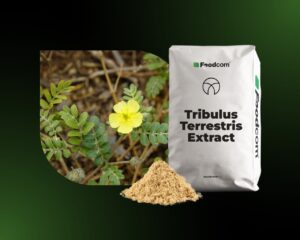
Tribulus terrestris belongs to the Zygophyllaceae family. It is a low-growing plant with spreading, creeping stems, small yellow flowers, and fruits with hard, sharp spines. It is found in Europe, Asia, and Africa, as well as on other continents. It grows in dry, open areas, including along roadsides.
In traditional herbal medicine, the fruits and above-ground parts of the plant were used. Today, they serve as raw material for botanical preparations, including powdered raw material and extracts. The various forms differ in their method of production and their content of plant compounds.
It is also important to note which part of the plant was used. The composition of the herb—that is, its above-ground parts—may differ from that of the fruit. This information should be included in the product documentation, as it helps users properly compare products and determine the scope of testing required before using the raw material.
Composition and properties of Tribulus terrestris
Tribulus terrestris contains, among other compounds, steroidal saponins, flavonoids, and other phenolic compounds. Their proportions vary depending on the plant’s origin, the part used, the stage of development, and the method of extract preparation. For this reason, two products described by the same botanical name may differ in their compositional profile.
Steroidal saponins hold a special place. These are natural plant compounds whose content is often determined during the testing of Tribulus terrestris extracts. This group includes, among others, protodioscin. Its concentration in the final preparation depends on the type of raw material used and the processing parameters.
Saponins and extract standardization
Commercially available extracts may have varying declared saponin contents. Standardization allows for the determination of the levels of selected substances and helps maintain consistent parameters across batches. For supplement manufacturers, this simplifies the selection of the appropriate amount of the ingredient for the formulation.
It is also important to check the method of analysis. Determining the total saponin content using UV spectrophotometry and identifying a specific compound via chromatography provide different insights into the composition. Therefore, a similar percentage result on two specifications may correspond to different protodioscin contents. This distinction facilitates the selection of an extract that meets production requirements.
Tribulus terrestris is also sometimes associated with testosterone and sports supplementation. In most clinical studies, testosterone levels remained essentially unchanged after the use of preparations derived from this plant. The results of studies on strength and muscle mass were also limited. Evaluating the effects of a specific product requires consideration of the extract’s composition, dosage, and duration of use, and health claims are subject to separate legal requirements.
How is Tribulus terrestris extract made?
Production begins with the preparation of the plant material. After harvesting, it is cleaned, dried, and ground, and then subjected to extraction using a carefully selected solvent. This allows the selected compounds to be transferred from the plant into the extract. Subsequent steps include separating plant residues, concentrating, and drying the extract.
The finished raw material may take the form of a powder intended for further processing. Its properties are determined by the extraction conditions, the drying method, and any auxiliary ingredients. In industrial production, moisture content, particle size, and bulk density are also analyzed. These parameters help predict how the powder will be dispensed and mixed with the other ingredients in the formulation.
Extract vs. powdered plant
Powdered tribulus is made from dried and ground plant material. An extract, on the other hand, is obtained by isolating selected substances through an extraction process. This allows for the concentration of specific compounds.
This difference must be taken into account when comparing the amount of an ingredient in the finished product. The same mass of extract and the same mass of powdered plant may provide different amounts of saponins. Therefore, calculations should be based on the documentation for a specific preparation, rather than on the botanical name alone as listed on the packaging.
The use of Tribulus terrestris in dietary supplements
Tribulus terrestris appears in single-ingredient supplements as well as in blends of various plant materials. Extracts are primarily used in capsules and tablets, and in appropriately formulated products, they are also used in powdered forms. The choice of dosage form depends on the composition of the blend, the method of administration, and the manufacturing capabilities of the facility.
In multi-ingredient preparations, Tribulus terrestris is sometimes combined with other botanical extracts, minerals, vitamins, or amino acids. Such combinations require an assessment of the composition of the entire batch and compliance with the requirements for the finished product. In practice, the production of dietary supplements also involves the selection of excipients, quality control, and the preparation of appropriate labeling.
During encapsulation, the flowability of the powder, the even distribution of the ingredient in the mixture, and the ability to achieve a consistent fill weight are important. In tablet manufacturing, the properties of the mass during compression also come into play. For this reason, a raw material that performs well in one formulation may require additional testing when changing the product form.
Storage under the conditions specified in the specifications helps protect the powder from moisture and maintain its parameters. The stability of the finished supplement, however, is evaluated for the entire formulation.
How to choose a Tribulus terrestris extract?
Before placing an order, it’s a good idea to determine which parameters will be needed to develop the formulation. Basic information includes the botanical name, the part of the plant used in production, the saponin content, and the method used to determine it. When comparing offers, the form of the powder, particle size, moisture content, and the presence of any carriers are also taken into account.
The documentation should include technical specifications and test results specific to a given batch. Depending on the intended use, tests are conducted for microbiological purity, heavy metals, pesticide and solvent residues, and other contaminants relevant to the raw material in question. The reproducibility of parameters is particularly important in mass production, where a change in the powder’s properties may necessitate additional testing.
In the case of tribulus, the plant part and the requirements of the target market must also be taken into account. The Polish position on the use of preparations made from the fruit includes specific conditions regarding the daily dose. The evaluation of the herb extract requires a separate assessment of its safety and suitability for use in a specific supplement. Furthermore, the information on the label and in advertising must comply with the requirements for health claims.
What affects the quality and availability of plant extracts?
The composition of plant material depends on growing conditions, harvest time, and storage methods. Therefore, extract manufacturers pay close attention to the origin of the raw material and the control of each stage of processing. Variations between batches can affect the content of specific compounds and the properties of the finished powder, which is important in large-scale production.
When making wholesale purchases, companies consider the quality of the extract, its availability, the type of packaging, and delivery terms. It is also important to be able to maintain consistent parameters, especially for raw materials used in regular production. Similar requirements apply to other botanical ingredients; their use is discussed in more detail in the article “Herbal extracts in industry.”
Tribulus terrestris extract in Foodcom S.A.’s product line
Foodcom S.A.’s product line includes Tribulus terrestris extract derived from the plant’s herb. The product is a fine, brown powder, standardized to contain at least 90% saponins as determined by the UV method. According to the specification, all of the material passes through an 80-mesh sieve, and the loss on drying is no more than 5%. The extract is packaged in 25-kg buckets and is intended for further industrial processing.
As a company specializing in the international trade of raw materials, Foodcom S.A. offers ingredients used in various manufacturing sectors, including the dietary supplement industry. Our collaboration with industrial customers includes selecting products that meet specific quality requirements and organizing deliveries tailored to the needs of businesses.
Tribulus terrestris in supplement production
Tribulus terrestris is a plant-based raw material used to produce extracts with varying saponin content. Its use in supplements depends on the composition, processing method, and requirements for the finished product. For manufacturers, the quality of the extract, the consistency of its parameters, and appropriately selected specifications remain particularly important. It is precisely these factors that allow Tribulus terrestris to be used in formulations that meet the needs of the supplement industry.