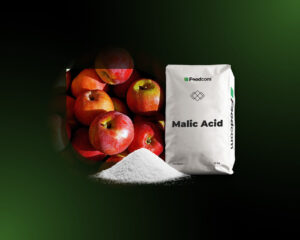
- Malic Acid is an organic chemical compound that occurs naturally in some fruits and vegetables.
- It is used as a preservative, color stabilizer and flavor enhancer.
- Malic Acid is used in the production of canned fruits, carbonated beverages, jams, chewing gum, candies, dressings and sauces.
- It is also used in the wine, animal feed, cosmetics, pharmaceutical and chemical industries.
Acidity regulators help to shape flavour, control pH and maintain consistent product characteristics. One such regulator is malic acid (E296), which is used in the food, dietary supplement, cosmetics and pharmaceutical industries. The raw material is mainly available as a white powder or granules, and its properties should be tailored to the specific application. In this article, we discuss the functions of malic acid, its applications and the parameters relevant to B2B purchasing.
What is malic acid?
In nature, this compound is found in apples, cherries and grapes, amongst other things. For industrial applications, however, a purified compound produced in a controlled process is used, rather than powder obtained directly from fruit. Although the term ‘apple acid’ is sometimes used, the correct Polish name is ‘malic acid’.
The molecule exists in D and L forms, and DL-malic acid is an equal mixture of the two. The L form is found in living organisms, but can also be produced industrially. The designation ‘L’ alone does not therefore confirm the natural origin of the raw material.
Physicochemical parameters
The values of these parameters depend on the form of the acid and the test method; therefore, when qualifying the raw material, one should refer to the specific product specification and the batch analysis certificate.
| Parameter | Value |
| Chemical name | 2-hydroxybutanedioic acid |
| E number | E296, DL-malic acid in the EU specification |
| molecular formula | C4H6O5 |
| molar mass | 134.09 g/mol |
| Form | white, odourless, crystalline powder or granules |
| solubility in water | at 20°C: DL 55.8 g/100 g water; L 36.3 g/100 g water |
| melting point | DL 131–132°C; L approx. 100°C |
| pKa (measure of acid strength) | pKa1 3.46; pKa2 5.10 at 25°C |
| storage conditions | dry place, airtight container, protection from moisture |
How is malic acid produced?
The production method depends on the required form. DL-malic acid is usually obtained chemically, whilst the L-form can be produced using enzymes or fermentation. The raw material is then purified, crystallised, dried and sieved.
Two products with the same name may differ in particle size, free-flowing properties and tendency to generate dust. Each batch should comply with the specification in terms of purity, impurities and physical characteristics.
Properties of malic acid
Its good solubility in water makes it easy to use this raw material in various products. It imparts a distinct, lingering acidity and pairs well with apple, cherry, berry and grape flavours. It can also be combined with other food-grade acids to alter the flavour profile.
The raw material absorbs moisture, so improper storage increases the risk of caking. Granulation is also important. The particle size affects how the raw material is used. A fine powder usually dissolves more quickly but produces more dust. A coarser fraction, on the other hand, can facilitate precise dosing.
Functions of malic acid
The functions of malic acid include pH regulation and flavour profiling. The pH level can affect the performance of preservatives, colourings and gelling agents, so the amount of E296 should be adjusted to suit the recipe.
In fruit products, malic acid balances sweetness and enhances sour notes. It can also reduce the aftertaste of sweeteners and even out differences in the acidity of juices and concentrates.
Malic acid and other acidity regulators
Different acidity regulators have distinct flavour profiles. Citric acid provides a quickly perceptible sourness, tartaric acid imparts a more astringent profile, whilst malic acid blends well with fruity notes. When making a choice, one should take into account the type of product, the desired flavour and the target pH level.
It is also possible to combine several acids in a single recipe to achieve the desired flavour profile. The result depends, amongst other things, on their proportions, the timing of their addition, the process temperature, and the content of sugar and buffering agents.
Applications of malic acid
Malic acid is used in the food, drinks, supplements, cosmetics, pharmaceuticals and animal feed industries. However, depending on the sector, the raw material must meet different quality and technological requirements.
Malic acid in food and drink
In practice, malic acid in food regulates the acidity of fruit preserves, jams, fillings, sauces, marinades and confectionery. It helps to minimise variations between batches of natural raw materials, whose flavour and pH vary depending on the variety and season.
In drinks, isotonic drinks, syrups and powdered mixes, E296 regulates the pH and balances the sweetness. This is also important in products with reduced sugar content.
Malic acid in jelly sweets and confectionery
In jelly sweets, E296 can be added to the mixture or used in a sour coating. It complements fruit flavours well, but the timing of its addition is crucial, as acidity affects the action of gelatine or pectin.
In sweets, coated sweets and chewing gum, the granulation and method of application of the raw material are also important.
Malic acid in tablets and supplements
In effervescent and lozenge tablets, E296 helps to regulate flavour and acidity. It also reacts with bicarbonate, leading to the release of carbon dioxide. It serves a similar function in sachets and powders.
It can also be used to produce the malates found in supplements. However, its mere presence does not justify attributing any therapeutic effect to the product.
Malic acid in cosmetics
Cosmetology is one of the areas of application for E296, which belongs to the group of alpha-hydroxy acids, or AHAs. In cosmetology, malic acid is primarily used to regulate pH. It is used in toners, exfoliants, gels and emulsions. The effect of a cosmetic product depends on its concentration, final pH and other ingredients; therefore, each formulation requires a safety assessment.
The same raw material is used in hair care products. Malic acid is used in hair conditioners, masks and rinses, where it can help to lower the pH. However, the final effect depends on the overall composition of the cosmetic product.
Malic acid in medicine and pharmacy
In medicine and pharmacy, malic acid primarily serves a technological rather than a therapeutic function. It helps regulate the pH and taste of oral preparations and is used in effervescent formulations. Raw materials for pharmaceutical applications may be subject to different quality requirements than those for food products.
Malic acid in animal feed and premixes
In the European Union, DL-malic acid is designated as feed additive code 1a296 and belongs to the group of preservatives. The food-grade designation E296 alone is insufficient in this context. Conditions of use must comply with feed regulations.
Comparison of uses
| Industry | Function | Significance for the manufacturer |
| Beverages | pH and flavour adjustment | balancing sweetness and fruity notes |
| Confectionery | adding a sour flavour | flavour and texture control |
| fruit processing | adjusting acidity | minimising batch-to-batch variations |
| dietary supplements | flavour adjustment and carbonation | control of formulation parameters |
| cosmetics | pH adjustment and AHA function | tailoring formulation properties |
| pharmaceuticals | pH and taste adjustment | compliance with product requirements |
| animal feed and premixes | preservative function | compliance with feed regulations |
Products containing malic acid
Depending on the formulation and legal requirements, the raw material may be found in various end products:
- carbonated and non-carbonated drinks, isotonic drinks and syrups;
- jelly sweets, sweets, coated sweets and chewing gum;
- jams, mousses, fillings and fruit preserves;
- sauces, marinades and dressings;
- effervescent tablets, lozenges and sachets;
- powders for making drinks;
- toners, scrubs, emulsions and hair care products;
- premixes and authorised compound feed.
Malic acid and apple cider vinegar
E296 is a compound supplied as a powder or granule, the specifications of which are confirmed by documentation. Apple cider vinegar is a liquid fermentation product, and its main acidic component is acetic acid.
The crystalline raw material can be precisely dosed in dry products. Vinegar introduces water and a characteristic aroma; therefore, it is not a direct substitute for E296 in tablets, powders and processes requiring strict pH control.
Quality parameters in B2B trade
Customers check the active ingredient content, the DL or L form, granulation and suitability for the intended use. Testing may cover roasting residues, heavy metals, microbiology, GMO status, allergens and the optical purity of the L form.
Documentation typically includes a specification, a safety data sheet and a certificate of analysis. Depending on the industry, regulatory declarations and proof of origin may also be required.
Particle size affects dosing, mixing, dissolution and dust formation. The choice between powder and granules should be based on process conditions. A change in supply source may require a new process trial.
Malic acid – where to buy?
When selecting a supplier, you should confirm the form, particle size, intended use, pack sizes, availability and transport conditions. Up-to-date quality documents are also required.
Foodcom S.A. supplies malic acid to industrial customers, including in 25 kg bags. Availability, form and particle size are confirmed on a case-by-case basis. Documentation may include a product specification, a safety data sheet and a batch analysis certificate.
Selecting malic acid for a specific application
Depending on the industry and product type, the raw material can serve various functions. Its selection should therefore take into account the requirements of the formulation, the conditions of the manufacturing process and the expected outcome.
Before implementing E296, process trials should be carried out to check how it interacts with the other ingredients. This allows the appropriate product variant to be selected and ensures consistent production parameters.