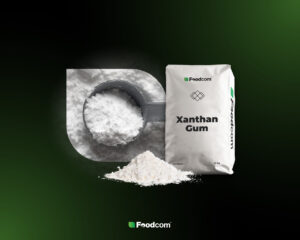
- Xanthan gum, also known as xanthan or E415, is a polysaccharide obtained through fermentation involving the bacterium Xanthomonas campestris.
- This ingredient is used as a food additive, among other things, to thicken and stabilize emulsions and suspensions, and to form viscous solutions in both cold and hot water.
- Various particle sizes are available on the market, including 80 mesh and 200 mesh, as well as gluten-free xanthan gum for specific applications.
Xanthan gum is one of the most versatile food additives used in modern industry. In practice, this ingredient is used wherever consistent texture, product stability, and easy viscosity control are essential—from sauces and desserts in the food industry to creams and gels in the cosmetics industry.
Xanthan gum – what is it?
Xanthan gum is a high-molecular-weight polysaccharide obtained through the fermentation of carbohydrates by strains of the bacterium Xanthomonas campestris. This is how it is defined by both EU regulations on food additives and U.S. FDA regulations. It is marketed under the names xanthan, xanthan gum, or the additive code E415.
The product consists of glucose, mannose, and glucuronic acid. It is typically produced from corn, wheat, or sugarcane, which undergo bacterial fermentation. The resulting xanthan is purified to remove foreign particles and other microorganisms, then dried and ground.
Properties of xanthan gum
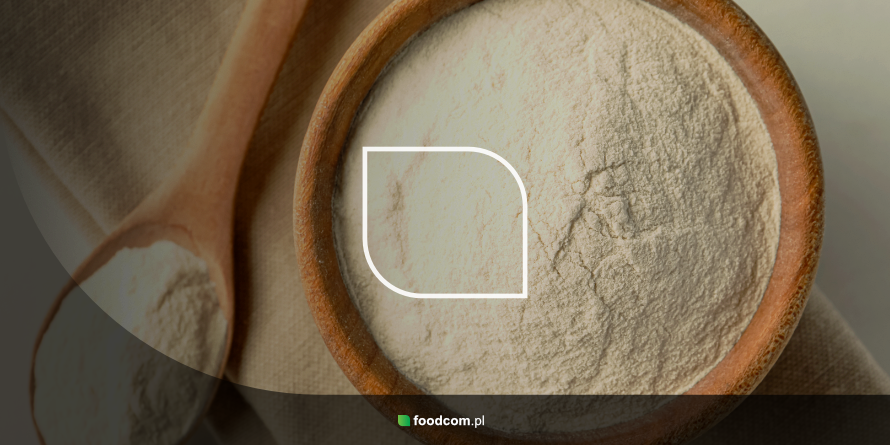
Xanthan gum is a white or yellowish, free-flowing powder with a neutral odor, characterized by high solubility in water and other liquids. It belongs to the hydrocolloids—in an aqueous environment, it swells to form a viscous solution. It dissolves in both hot and cold liquids across a wide pH range. It exhibits pseudoplastic behavior, meaning it thins under shear stress and rapidly regains its initial viscosity once the stress is removed. It is also hygroscopic, meaning it has the ability to absorb moisture. In mixtures, it prevents particle sedimentation, keeping them suspended in the liquid.
The most important industrial properties of xanthan gum stem from its texture-modifying action. Xanthan acts as:
- a stabilizer,
- emulsifier,
- thickening agent,
- a substance that aids in the formation of suspensions or foams,
- a texture enhancer, or a product that reduces separation.
Types of xanthan gum – what to look for?
The types of E415 available on the market are not different chemical variants, but rather varieties that differ in performance parameters such as purity, viscosity, compliance with specific standards, and particle size. For many manufacturers, particle size is particularly important—it affects the rate at which the raw material disperses and the ease of mixing during the production process.
Commercial offerings often include designations such as 80 mesh and 200 mesh—these terms refer to the material’s particle size distribution. Variants with different degrees of fineness are available on the market, e.g., 99% passing 80 mesh and 92% passing 200 mesh. A finer fraction usually facilitates faster and more uniform dispersion of the powder in the mixture.
Gluten-free xanthan gum
Xanthan gum is most commonly used in baking and gluten-free products. Gluten-free recipes lack the natural protein network responsible for elasticity and gas retention, which is why xanthan gum is often used. In these products, its role is to improve dough structure and baked goods quality—with the right dosage and amount of water, it can increase gas retention, thereby improving the volume and softness of baked goods.
Applications of xanthan gum
Xanthan gum is widely used in the food industry, particularly in confectionery, baking, and functional foods. It is also found in cosmetics, specifically in toothpastes, gels, and creams.
Other applications include:
- the oil and gas industry – it is used as a component of drilling fluids;
- the pharmaceutical industry – used as a thickening agent, to delay the release of the active ingredient from a tablet, and as a component of protective preparations and artificial saliva;
- use as an ingredient in paints, textile dyes, fungicides, fertilizers, and adhesives.
Xanthan gum in food
The most obvious application of xanthan gum is in food. It is most commonly used as a stabilizer, emulsifier, thickener, and suspending agent. In practice, this means it is widely used wherever a uniform consistency and reduced separation are important. It works across a wide pH range and is also resistant to temperature fluctuations, varying salt concentrations, enzymatic activity, and sterilization or pasteurization processes.
Xanthan gum is found, among other things, in:
- sauces and dressings,
- mayonnaise, mustard,
- instant mixes,
- desserts, ice cream, and fillings,
- yogurts, cottage cheese, kefir,
- jams and jellies,
- beverages,
- canned goods,
- baked goods,
- plant-based products.
From a technological standpoint, xanthan gum in food helps keep particles in suspension, improves texture, and stabilizes the water-fat system. This is particularly important in products for vegetarians and vegans, as well as in low-calorie foods, where the addition of fat is insufficient to ensure the proper texture. Xanthan gum can serve as a substitute for gelatin, eggs, or flour and starch, thickening and stabilizing the product.
Foods containing xanthan gum not only have an improved texture but are also more resistant to enzymes that alter product properties and to temperature fluctuations, such as heating, freezing, and thawing.
Xanthan gum in cosmetics
In cosmetics, xanthan gum functions as a texturizer, emulsion stabilizer, and gelling agent. It can be used at concentrations ranging from 0.01% to 10%. Its presence aids in viscosity control, combining product ingredients with different phases, maintaining formula homogeneity, and facilitating application and dispensing.
This ingredient is commonly found in toothpaste, gels and skin care creams, cleansing products, lotions, makeup removers, and hair care products.
Xanthan gum – where to buy?
It depends on your needs and the scale of application. For industrial use, key factors include quality parameters, batch consistency, technical documentation, and the availability of variants tailored to the manufacturing process.
Due to the seasonal demand for xanthan gum and its growing popularity driven by increased production of gluten-free and vegan foods, consistent availability of the raw material is crucial. In the B2B segment, one of the most trusted suppliers is Foodcom S.A., which offers xanthan gum from verified sources in various particle sizes.
This raw material combines several important technological functions: it thickens, stabilizes, improves texture, and promotes product uniformity. As E415, it is well-recognized in food law, safe for health, and widely used by food and cosmetics manufacturers. Its advantage lies in its versatility – xanthan gum works well in both toothpaste and gluten-free foods, performing its functions excellently in products with varying pH levels and temperatures.