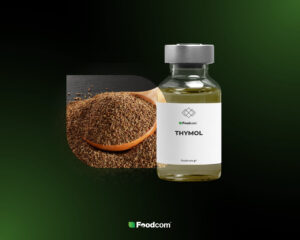
- Thymol as a monoterpene phenol found in thyme and oregano essential oils.
- Antioxidant, antimicrobial and aromatic properties.
- Applications in the food, cosmetics, pharmaceutical and chemical industries.
- Importance of purity, origin and quality parameters in industrial production.
Natural ingredients have been gaining increasing importance for years in many industries, particularly in those where the quality, safety, and functionality of the raw materials used are critical. One of the most valued plant-derived compounds is thymol—a substance with distinctive chemical properties used, among others, in the food, cosmetics, pharmaceutical, and chemical industries. What exactly is it, how is it obtained, and why is it so widely used?
What is thymol?
Thymol is an organic chemical compound belonging to the group of monoterpene phenols. It occurs naturally in the essential oils of many plants, particularly in common thyme (Thymus vulgaris), from which it derives its name. The substance is responsible for the characteristic, intense aroma reminiscent of spicy herbs.
In industry, thymol is used primarily for its biological, aromatic, and stabilizing properties. It exhibits antimicrobial and antioxidant effects, making it suitable for products requiring protection against adverse chemical processes and the growth of microorganisms. Thymolum—as it is also known in certain pharmaceutical and technological applications—is a high-purity compound available in the form of white or colorless crystals. It is characterized by low solubility in water but dissolves well in alcohol and other organic solvents.
How is thymol obtained?
Thymol can be obtained both from natural essential oils and through chemical synthesis. Traditionally, it was primarily obtained by isolating it from thyme oil or oregano oil, which contain high concentrations of this compound. Extraction from plant materials most commonly involves steam distillation, during which the individual components of the essential oils are separated. Thymol is then purified to obtain a substance with the appropriate quality parameters.
Due to growing industrial demand, chemical synthesis methods are also being used more frequently. These methods ensure consistent product quality, reproducible properties, and the ability to produce larger quantities of the raw material. The extraction method depends on the intended use and purity requirements. In industries such as pharmaceuticals and food processing, appropriate quality standards and control of physicochemical parameters are particularly important.

What are the properties of thymol?
Thymol is distinguished by a number of properties that make it a valued ingredient in many industrial products. Its most important characteristics include:
- strong antioxidant activity,
- the ability to inhibit the growth of certain microorganisms,
- a distinctive aroma and flavor,
- chemical stability,
- the ability to protect ingredients from oxidation.
Thymol is used as a natural ingredient that helps extend product shelf life. Like other food antioxidants, it helps limit oxidation processes that can affect the quality, taste, aroma, and appearance of products.
The Use of Thymol in the Food Industry
One area of application for this organic compound is the food industry. The substance can be used as an ingredient to support product stability and improve their sensory properties. Thanks to its antioxidant properties, thymol reduces adverse changes that occur during food storage. Oxidation processes can lead, among other things, to a deterioration in the taste, aroma, or nutritional value of products, which is why manufacturers are seeking effective solutions to preserve their quality.
The food industry also uses substances that regulate product properties, such as acidity regulators, which help maintain the appropriate technological parameters of food. Thymol may be an ingredient in formulations used in certain food products, although its use depends on applicable regulations and the product’s intended use.
Thymol in Cosmetics and Pharmaceuticals
Thymol is also widely used in the cosmetics and pharmaceutical industries. Its properties make it suitable for use in skin care products, oral hygiene products, and cleansing formulations. It can be found, among other things, in mouthwashes, toothpastes, and other hygiene products. Its distinctive aroma makes it a popular ingredient in fragrance formulations. In the pharmaceutical industry, thymol is used as an excipient or an active ingredient in selected formulations. For many years, it has been of interest to manufacturers of medicinal products and hygiene-supporting formulations.

The Use of Thymol in Other Industries
In addition to the food, cosmetics, and pharmaceutical industries, thymol is also used in other sectors of the economy. It is used, among other things, in:
- the production of cleaning agents,
- formulations with protective properties,
- products used in agriculture,
- laboratory research and industrial applications.
Its versatility stems primarily from a combination of its chemical properties, stability, and natural plant-based origin.
Thymol—where to buy high-quality raw material?
Companies that use thymol in their production processes should choose trusted suppliers who guarantee high quality and provide appropriate product documentation. The raw material’s technical specifications, purity, and compliance with industry-specific requirements are of critical importance. Foodcom S.A. specializes in supplying high-quality raw materials to the food industry and other sectors, supporting companies in selecting the right ingredients for their production processes.
Thymol—a Natural Ingredient with Broad Potential
Thymol is a compound with unique properties that, thanks to its functionality, is used in many industries. Extracted from natural essential oils or produced synthetically, it is a valuable raw material used in the production of food, cosmetics, pharmaceuticals, and industrial products.
Growing interest in natural ingredients and solutions that support product shelf life means that the importance of substances such as thymol is constantly increasing. A carefully selected raw material from a trusted supplier allows manufacturers to create products that meet the demands of today’s market.