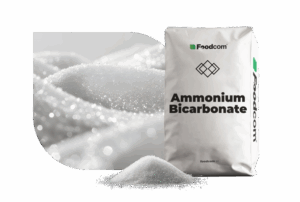
- Ammonium bicarbonate (E503) as a leavening agent.
- Use in the production of biscuits, crackers, wafers and shortbread cookies.
- Light and crisp texture created by gases released during baking.
- Importance of raw material purity and consistent supplies in industrial production.
Ammonium bicarbonate is a highly valued raw material used primarily in the food industry, where it plays a significant role in processes related to the production of baked goods and confectionery. It aids in the leavening process, giving the finished products the right structure and desired texture. The substance is also known as the food additive E503 and has been used for many years in the recipes of food manufacturers around the world.
What is ammonium bicarbonate, and what are its properties?
Ammonium bicarbonate (NH₄HCO₃) is an inorganic chemical compound belonging to the group of ammonium salts. At room temperature, it occurs as a white, crystalline powder. It dissolves well in water and decomposes when exposed to elevated temperatures. Unlike many other additives used in the food industry, ammonium bicarbonate is distinguished by its characteristic mode of action—when heated, it decomposes, releasing carbon dioxide, ammonia, and water. This process is responsible for the leavening effect, which is particularly desirable in the production of certain types of food products.
Its most important technological properties include:
- effective leavening action,
- high chemical purity,
- predictable performance in production processes,
- suitability for use in specific food formulations,
- good solubility and ease of dosing.
How is ammonium bicarbonate produced?
The industrial production of ammonium bicarbonate is based on a chemical reaction between ammonia, carbon dioxide, and water. When these components are combined, a solution containing the appropriate ammonium compounds is formed, which are then subjected to crystallization and purification processes. Production requires precise control of process parameters, as the final product quality depends, among other things, on:
- the purity of the raw materials used,
- the course of the reaction process,
- crystallization conditions,
- the drying method,
- control of the final physicochemical parameters.
Modern production facilities use advanced monitoring systems that ensure the consistency of each product batch. This is particularly important in the food industry, where even slight differences in quality affect the product’s properties.

E503 – The Importance of Ammonium Bicarbonate in the Food Industry
In the food industry, ammonium bicarbonate is used as an additive designated by the code E503. Its primary function is to aid the leavening process, which is why it is primarily used in products where the gases produced during baking can be completely removed. It is particularly popular in the production of low-moisture products, as it is most effective under such conditions. It is used, among other things, in the production of:
- biscuits,
- shortbread cookies,
- crackers,
- dry confectionery,
- wafers,
- selected baking mixes.
For products with higher moisture content, the use of ammonium bicarbonate requires appropriate formulation adjustments, as ammonia residues may affect the final taste and aroma. Modern food production also uses other processing aids, such as acidulants, which help maintain the proper recipe parameters and process stability.
The Use of Ammonium Bicarbonate in Various Production Processes
Ammonium bicarbonate is most significant for its use in the food industry, which stems from its chemical properties, particularly its ability to decompose in a controlled manner. In the baking and confectionery sectors, it serves as an ingredient that supports the structure of products. It helps achieve the desired crispness, lightness, and characteristic texture of baked goods. Manufacturers choose it when they want to:
- improving the physical properties of their products,
- maintaining recipe consistency,
- an efficient baking process,
- minimizing the risk of quality variations between production batches.
Ammonium bicarbonate is also used as an ingredient in processing mixes and semi-finished products used in the food industry.
The Impact of Ammonium bicarbonate Quality on the Production Process
When it comes to raw materials used on an industrial scale, the mere presence of a specific chemical compound is not the sole selection criterion. What matters is the product’s quality, origin, and the stability of its parameters. When purchasing, pay attention to:
- the product’s compliance with food industry requirements,
- availability of quality documentation,
- the consistency of individual shipments,
- appropriate transport and storage conditions,
- the supplier’s experience in serving the industry.
Stable access to food ingredients reduces the risk of downtime and ensures the continuity of production processes. This is particularly important in large production facilities, where even minor disruptions in supply can affect the production schedule.
Where can you buy ammonium bicarbonate?
When choosing a supplier of ammonium bicarbonate, the most important factors to consider are product quality, the availability of documentation, and the ability to ensure regular deliveries. For food manufacturers, it is essential that the raw material used meets specific requirements and is suitable for industrial applications. There are companies on the market that specialize in distributing ingredients for the food industry, such as Foodcom S.A., which offer a wide range of products used by manufacturers across various sectors.
Ammonium Bicarbonate and Stable Production
Ammonium bicarbonate remains one of the key raw materials used in the food industry. Its unique technological properties make it particularly suitable for the production of products requiring a specific structure and strict specifications. A properly selected raw material helps streamline production processes, maintain high product quality, and meet the demands of today’s food market.